
The Definitive Guide to AI Bill of Materials (AI-BOM): Security, Governance, and Transparency
This comprehensive guide explains how to build an AI Bill of Materials (AI-BOM)-a machine-readable inventory of all models, datasets, and dependencies
AI RISK INTELLIGENCEAI GOVERNANCE
Harshaun Singh
2/24/20263 min read
The Definitive Guide to AI Bill of Materials (AI-BOM): Security, Governance, and Transparency
As organizations rapidly scale their artificial intelligence operations—with 88% of companies now reporting regular AI use—the complexity of managing AI risks has grown exponentially. To address this, the AI Bill of Materials (AI-BOM) has emerged as a critical tool for providing the visibility needed to secure, govern, and audit AI systems efficiently.
What is an AI-BOM?
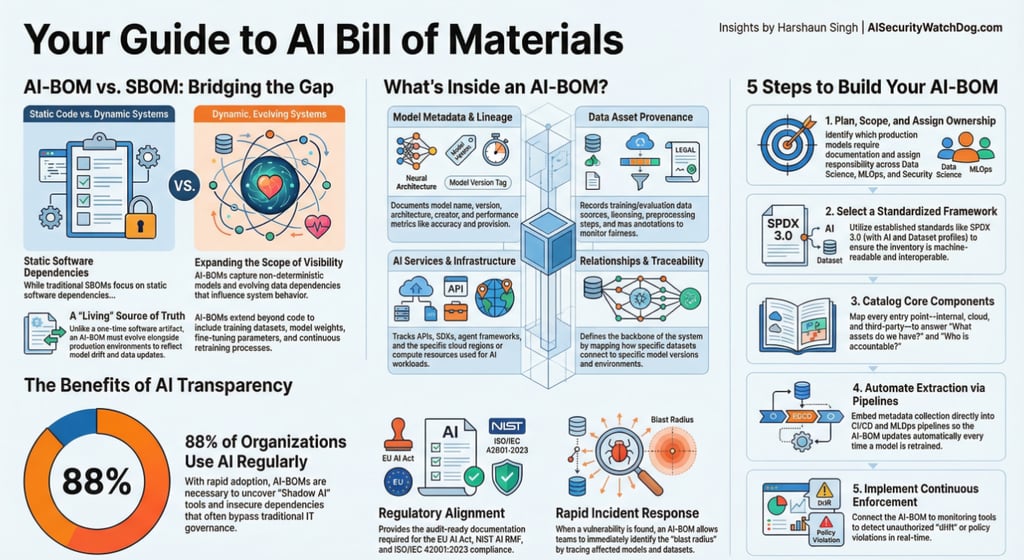
An AI-BOM is a complete, machine-readable inventory of the assets that make up an organization’s AI ecosystem. Unlike a simple list, it captures the complex relationships between models, datasets, services, infrastructure, and third-party dependencies. It acts as a map or schema that provides the traceability needed to understand how an AI system actually operates in production.
Core Components of a Comprehensive AI-BOM:
Models: Includes foundation, hosted, and fine-tuned models, along with their versions and configurations.
Data Assets: Training, fine-tuning, evaluation, and inference-time datasets.
AI Services & Interfaces: APIs, SDKs, agent frameworks, and orchestration layers.
Dependencies: ML frameworks (like PyTorch or TensorFlow) and third-party libraries.
Infrastructure: Compute, storage, and cloud environment details.
Lineage & Relationships: How models connect to specific data and services, which determines the potential "blast radius" during a security incident.
AI-BOM vs. SBOM: What’s the Difference?
While a traditional Software Bill of Materials (SBOM) tracks static software components, an AI-BOM is purpose-built for the non-deterministic nature of AI. SBOMs focus on code, but AI behavior is shaped by training data, model weights, and continuous retraining processes. The AI-BOM extends the SBOM concept to include these dynamic elements that influence system behavior over time.
--------------------------------------------------------------------------------
How to Build an AI-BOM: A Step-by-Step Guide
Building an AI-BOM should be treated as part of your organization's infrastructure rather than a one-time paperwork exercise. Follow these steps to develop a living source of truth:
1. Define Scope and Ownership Start by identifying which AI systems the AI-BOM should cover—production and externally sourced models are high priorities. Assign clear ownership: data scientists provide model lineage, MLOps teams handle automation, and security leads oversee the entire lifecycle.
2. Select a Standardized Framework To ensure your AI-BOM is interoperable across different tools, use established frameworks like SPDX 3.0.1. SPDX provides official AI and Dataset profiles that standardize how to describe architecture, data sources, and licensing in a machine-readable format.
3. Catalog Your Components Create an initial inventory that records the core assets, including data sources, model types, and hardware. Beyond technical specs, you should also document known issues, biases, and ethical considerations to support responsible AI adoption.
4. Automate Extraction via ML Pipelines Manual updates do not scale. Embed metadata collection directly into your CI/CD and MLOps pipelines. This ensures that every time a model is retrained or a dependency is updated, the AI-BOM is automatically refreshed with the latest parameters and environment data.
5. Validate, Version, and Sign Once data is collected, run validations against SPDX schemas to ensure the relationships make sense. Version your AI-BOM alongside the model it describes and add a cryptographic signature to verify its authenticity and prevent tampering.
6. Operationalize and Monitor Integrate the AI-BOM with your vulnerability management and compliance tools. Use it for continuous monitoring to detect unauthorized changes or "model drift," which could introduce security vulnerabilities.
--------------------------------------------------------------------------------
Why AI-BOMs are Essential for Modern Enterprise
Implementing an AI-BOM offers several high-stakes benefits:
Regulatory Compliance: It provides the documentation needed to align with frameworks like the EU AI Act and the NIST AI Risk Management Framework (AI RMF).
Security & Risk Management: AI-BOMs help identify "shadow AI," unvetted datasets, and risks like data poisoning or model tampering.
Transparency and Trust: They allow stakeholders to understand how AI systems operate and what safeguards are in place, which is crucial for strategic initiatives.
Incident Response: In the event of a breach, an AI-BOM allows teams to immediately trace which model or dataset was involved, speeding up mitigation.
--------------------------------------------------------------------------------
References
WatchDog Wire
Bridging the gap between AI innovation and cybersecurity. Explore our AI Risk Intelligence & Governance Briefs.


AI Security WatchDog
AI Risk Intelligence & Governance Briefs. Weekly insights on AI Incidents, regulations and vendor risks.
Contact
info@AISecurityWatchdog.com
Subscribe
© 2025. All rights reserved.