
ISO 27001 vs. ISO 42001 Certification: What’s the Difference?
Discover the key differences and similarities between ISO 27001 and ISO 42001, and learn how to leverage your existing security framework to build a robust foundation for ethical AI governance.
AI RISK INTELLIGENCEAI GOVERNANCE
Harshaun Singh
2/24/20263 min read
ISO 27001 vs. ISO 42001 Certification: What’s the Difference?
As artificial intelligence (AI) becomes central to business operations, organizations face new challenges in governance and security. While ISO 27001 is the established gold standard for information security, the newer ISO 42001 framework has emerged specifically to promote the responsible development and deployment of AI. Understanding the relationship between these two is critical for any modern, tech-driven business.
Core Focus and Major Contents
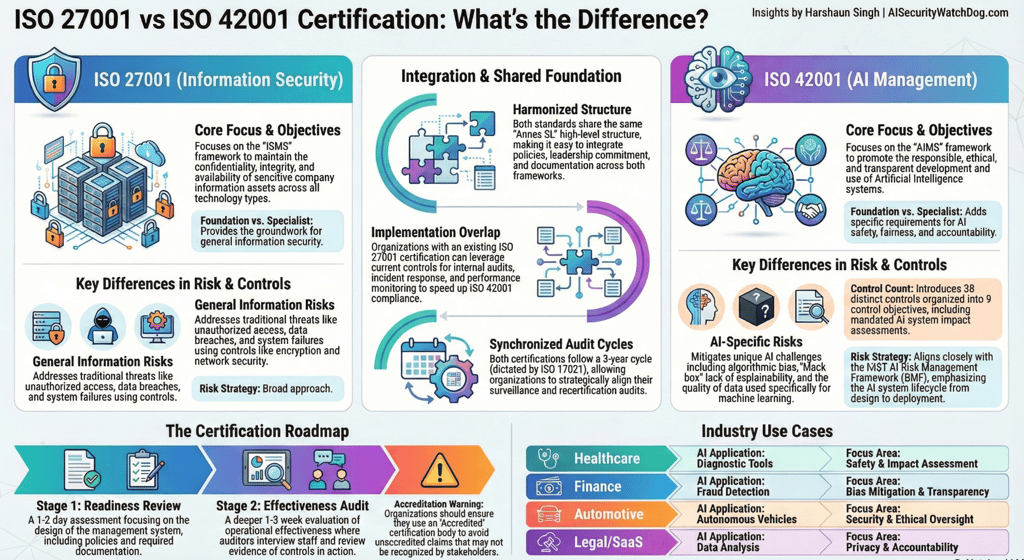
ISO 27001: The Information Security Standard ISO 27001 focuses on establishing an Information Security Management System (ISMS). Its primary goal is to protect sensitive information assets through a systematic risk management process, ensuring data remains secure.
Major Contents: It encompasses people, processes, and IT systems, applying controls such as access control, encryption, network security, and operational security.
Objective: To manage information security risks broadly across various technologies.
ISO 42001: The AI Management Standard ISO 42001 is the first international standard for Artificial Intelligence Management Systems (AIMS). It provides a comprehensive framework for AI governance, addressing security, safety, privacy, fairness, and transparency.
Major Contents: It includes 38 distinct controls organized into 9 objectives, covering the AI system lifecycle, data quality, and model transparency.
Objective: It moves beyond traditional security to address ethics, bias mitigation, and the societal impacts of AI.
Key Similarities
Despite their different focuses, the two standards are built on a similar foundation:
Management System Structure: Both follow a "High-Level Structure" that includes requirements for leadership commitment, internal audits, performance evaluation, and continual improvement.
Risk-Based Approach: Each framework relies on a systematic process to identify, evaluate, and treat risks—though the nature of those risks differs.
Certification Process: Both follow the ISO 17021 audit process, which includes a Stage 1 readiness assessment and a Stage 2 operational audit, followed by a 3-year certification cycle with annual surveillance.
Leveraging ISO 27001 for ISO 42001
One of the most significant advantages for modern organizations is that ISO 27001 serves as a foundation for ISO 42001. If you already have a certified ISMS, you are not starting from scratch.
Existing Controls: Organizations can leverage their existing ISO 27001 controls for ISO 42001 compliance, particularly in areas like risk assessment, internal audits, incident response, and performance monitoring.
Unified Governance: Integrating these standards allows for a harmonized approach to Governance, Risk, and Compliance (GRC), ensuring consistency across security and AI-specific considerations like fairness and transparency.
Operational Efficiency: You can adapt existing management resources—such as documented information, training programs, and communication channels—to include AI-specific requirements, which streamlines the implementation of an AIMS.
Consolidated Audits: Because they follow the same certification cycle, organizations can strategically align their ISO 42001 audit with their ISO 27001 audit, reducing the overall burden on the business.
Critical Differences
The primary difference lies in the scope of risks they address:
Security vs. Governance: ISO 27001 is about keeping data secure from unauthorized access. ISO 42001 is about ensuring AI systems are trustworthy, ethical, and accountable.
Specific AI Controls: ISO 42001 introduces unique requirements not found in ISO 27001, such as AI system impact assessments and the evaluation of algorithmic bias.
Data Focus: While ISO 27001 protects data as an asset, ISO 42001 focuses on data quality and provenance specifically for training machine learning models.
What is Needed When?
You need ISO 27001 if:
You handle sensitive client data and need to prove a robust security posture to stakeholders.
You are looking to build a foundational security framework that covers all IT operations.
You need ISO 42001 if:
You are an AI model provider, SaaS provider, or developer integrating AI into products.
You are subject to emerging regulations like the EU AI Act, which emphasizes AI safety and governance.
You want a competitive advantage by demonstrating a commitment to ethical AI and responsible risk management.
References
ISMS.online: ISO 42001 vs ISO 27001 Explained
Cloud Security Alliance (CSA): ISO 42001: Lessons Learned from Auditing and Implementing the Framework
A-LIGN: The Intersection of ISO 42001 and ISO 27001
WatchDog Wire
Bridging the gap between AI innovation and cybersecurity. Explore our AI Risk Intelligence & Governance Briefs.
AI Security WatchDog
AI Risk Intelligence & Governance Briefs. Weekly insights on AI Incidents, regulations and vendor risks.
Contact
info@AISecurityWatchdog.com
Subscribe
© 2025. All rights reserved.